
perovskite
competence
cluster
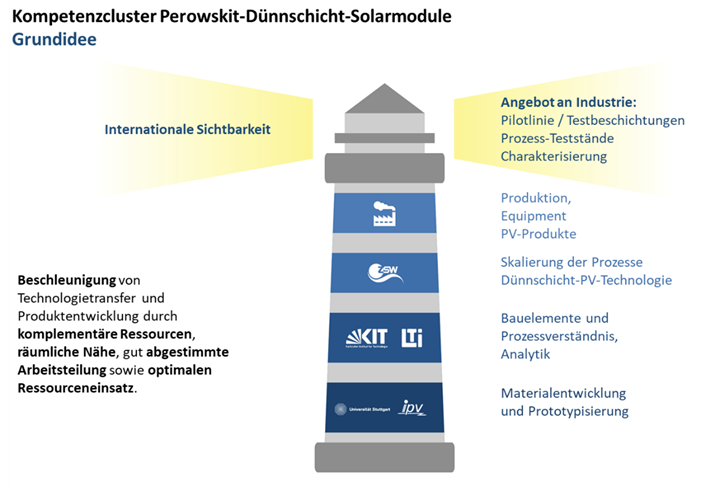
Competence cluster for the production of Perovskite thin film modules in Baden-Württemberg and Germany.
The competence cluster realizes the production of Perovskite Thin Film Solar Modules for the PV industry in Baden-Württemberg and Germany. This is done by building a industry-related and Interinstitutional Production Engineering.

Event tip: 5th Perovskite workshop Baden-Württemberg on 05.10.2026
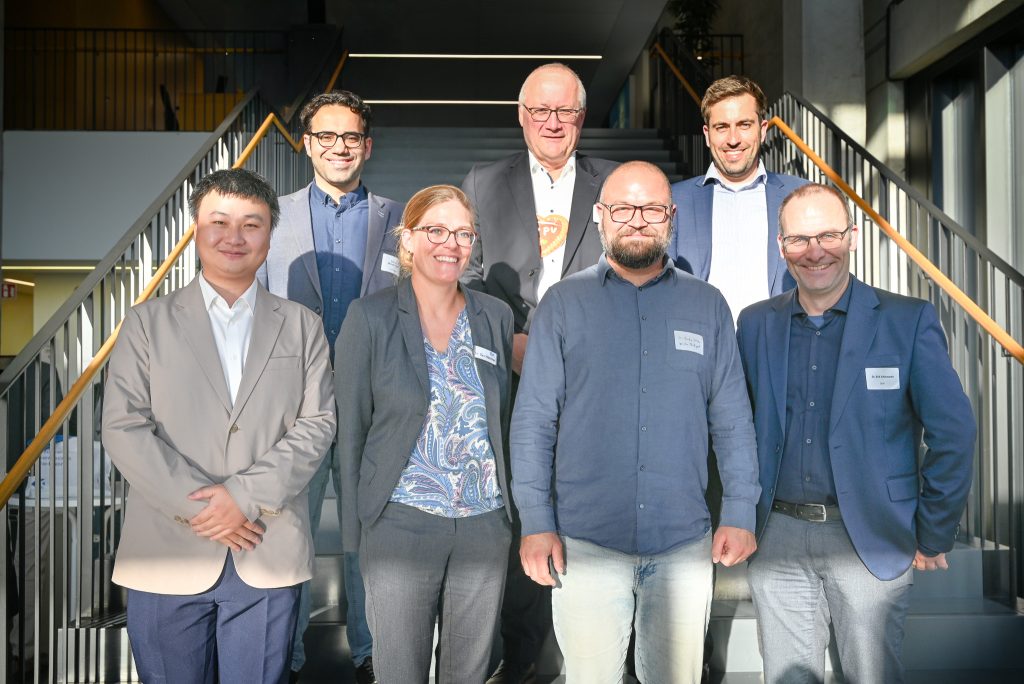
The Institute for Photovoltaics (ipv) at the University of Stuttgart organizes together with the Zentrum für Sonnenenergie- und Wasserstoff-Forschung Baden-Württemberg (ZSW), the Karlsruhe Institute for Technology (KIT) and the Fraunhofer ISE on 5th October 2026 the 5th Perovskite workshop Baden-Württemberg. Venue is the Institute for Photovoltaics (IPV) University of Stuttgart. Selected Keynote lectures give an insight into Latest topics perovskite research which will then be discussed in the plenum.
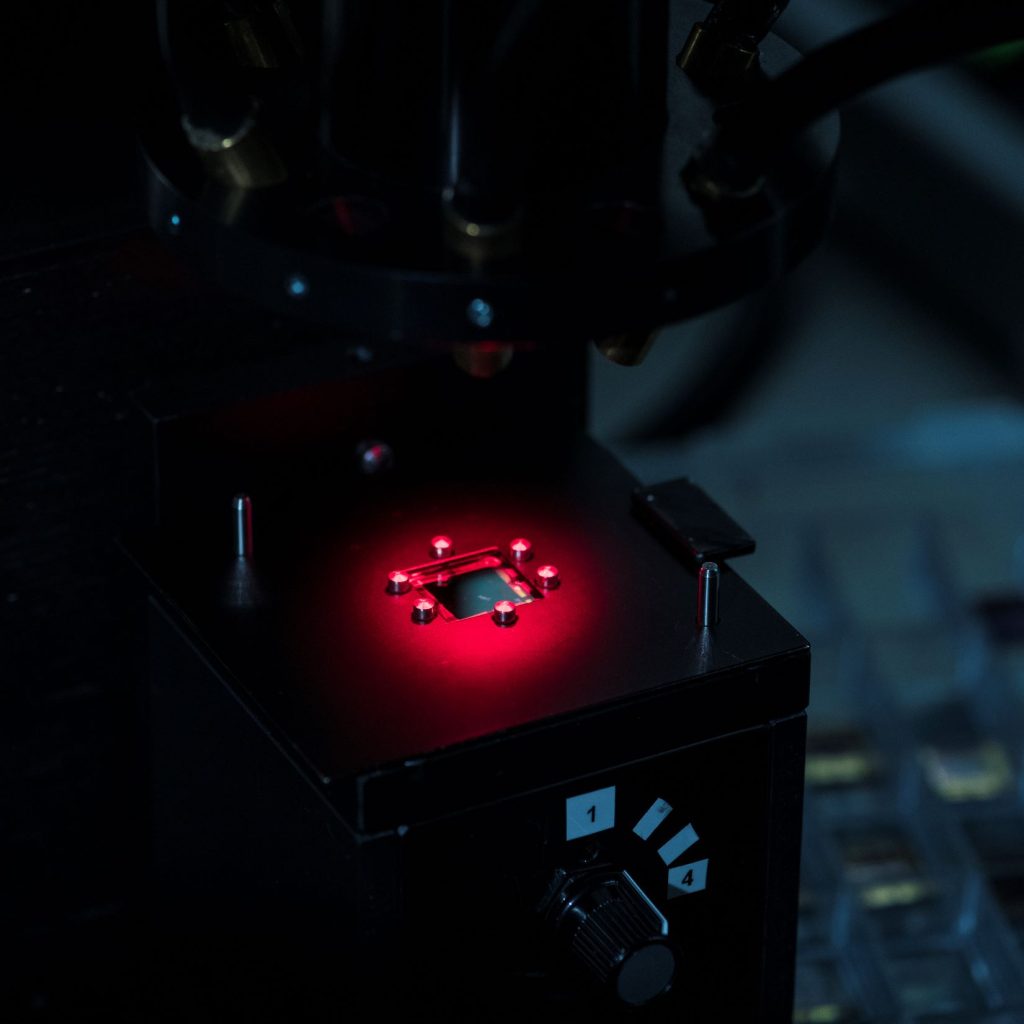
Photo: The special crystal structure of the perovskite enables solar cells with high efficiency. In the tandem, the power yield is even greater. (Photo: Dr. Bahram Abdollahi Nejand, Kit)
The Perovskite Competence Cluster
the projects
Thanks to its long-standing, successful cooperation, the competence cluster combines research excellence and industrial application in a unique way.
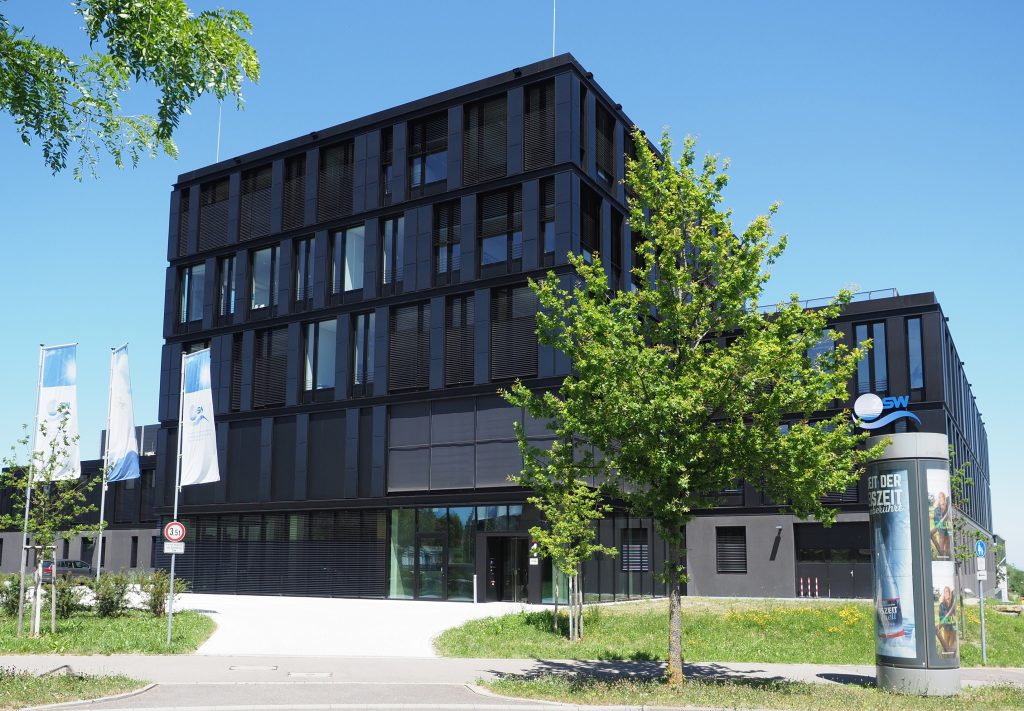
The first attachments and activities (Perotec 1-3 and peroup) For commissioning, the ZSW has already been financially supported by the Ministry for the Environment, Climate and Energy Management Baden-Württemberg supported.

With the current project peroclu1 the next decisive step is now taken: the Targeted upscaling of perovskite solar cells. The project receives a strong financial start-up – with Funding by the Federal Ministry of Economics and Energy (BMWE) as well as from Ministry of Economics, Crafts and Tourism Baden-Württemberg. PeroLu1 is thus sending a clear signal for the industrial future of this key technology.

Thanks to complementary expertise, technology transfer and product development takes place across the entire value chain.
We offer excellent technology transfer
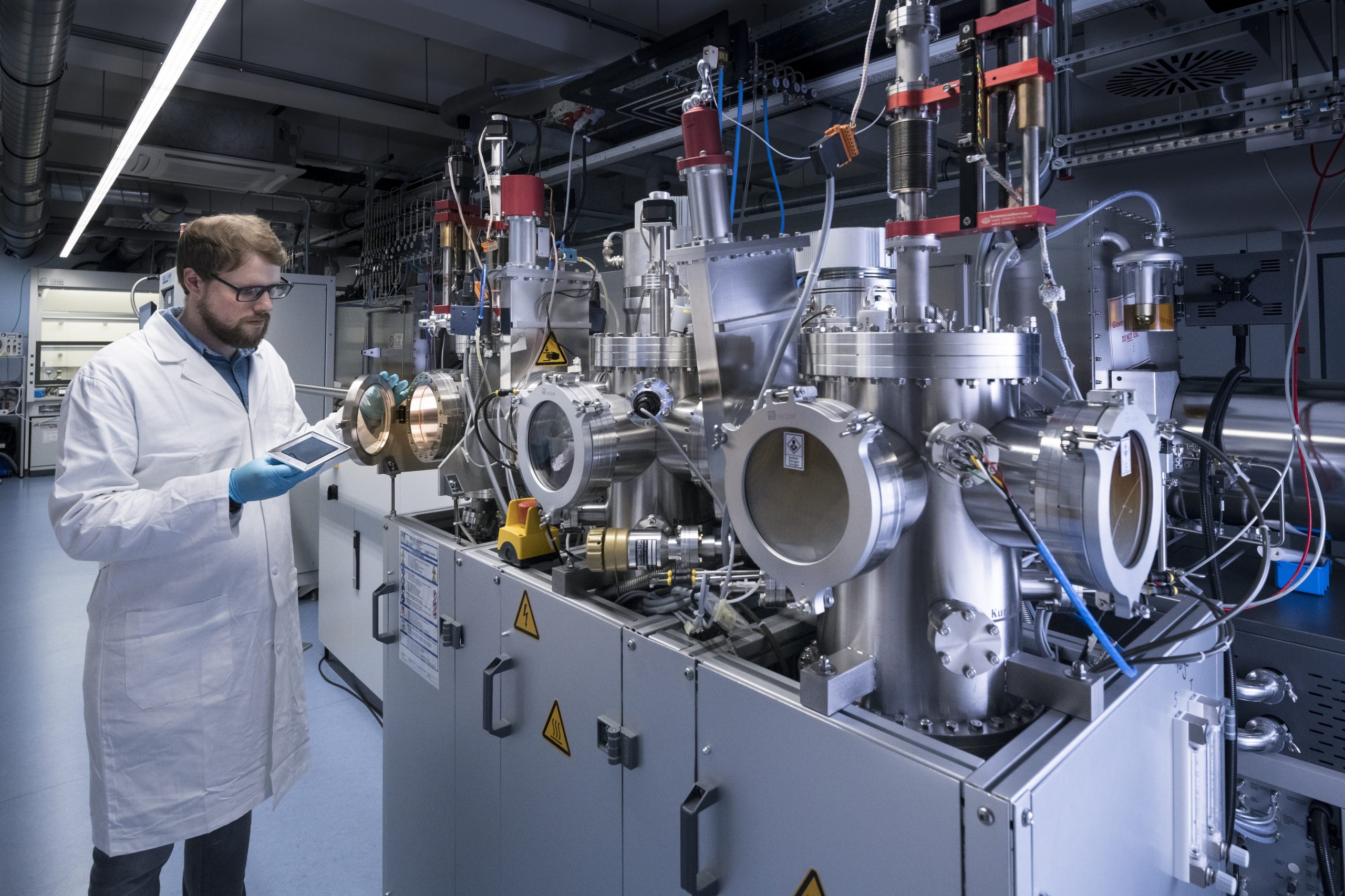
Our Process Technologies
- Spin Coating
- slotted nozzle coating
- inkjet printing
- Thermal Evaporation
- Magnetron sputtering
- atomic layer separation
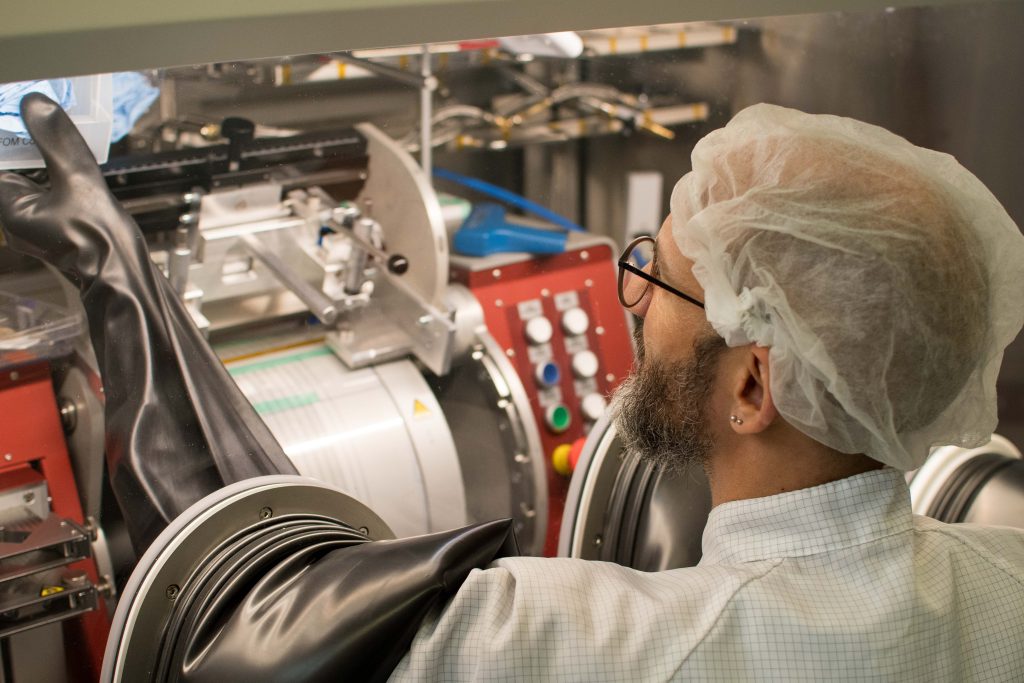
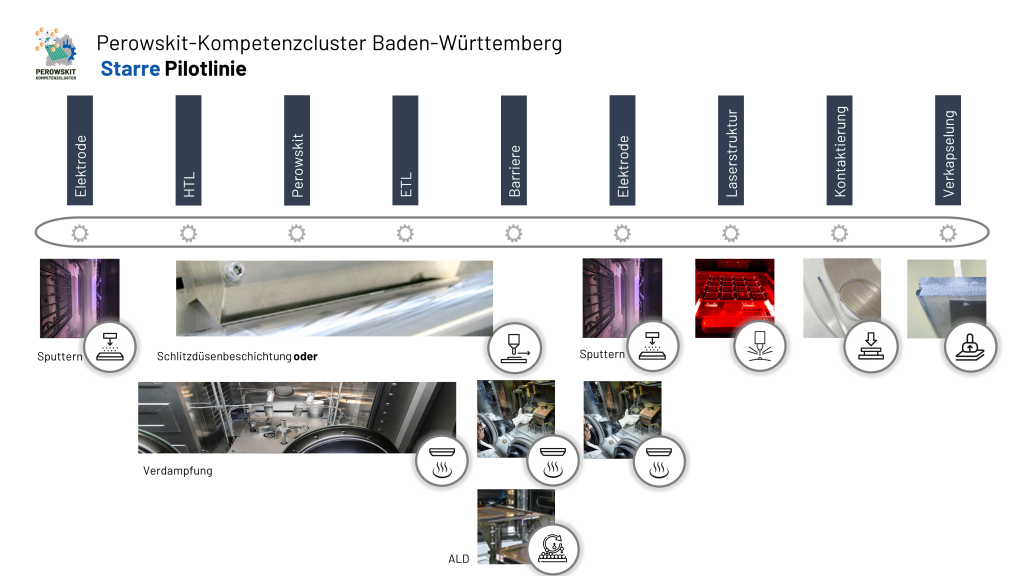
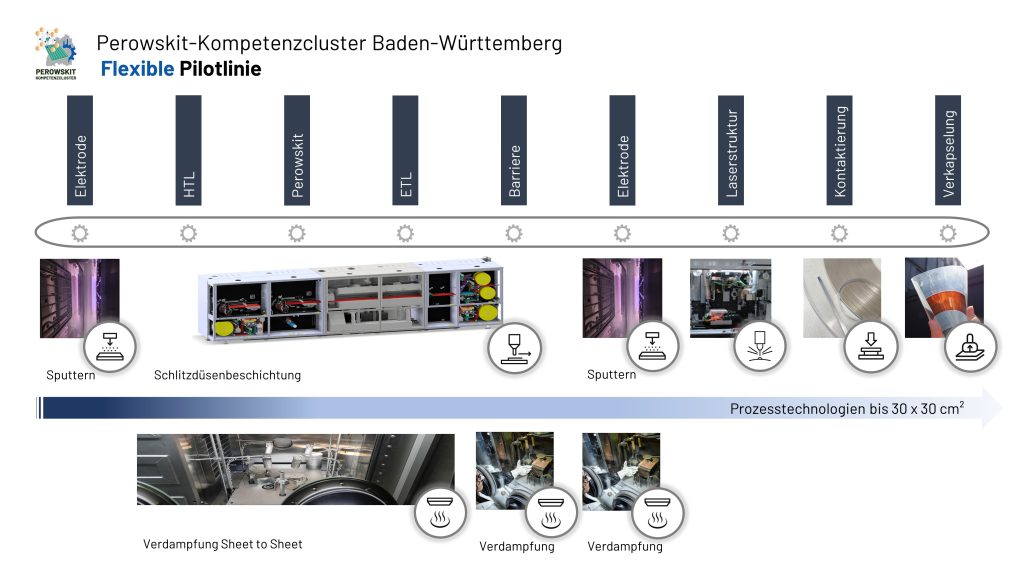
Our pilot lines – rigid and flexible
Why Perovskite?
Hybrid organic inorganic perovskite with ABX₃ structure form the basis of modern Perovskite solar cells (PSC) – one of the most promising, cost-effective thin-film technologies in photovoltaics.
Through the targeted combination of different cations, metals and halides the material properties can be precisely adjusted and adapted to specific applications.


In just a few years, Perovskite solar cells recorded an unprecedented leap in efficiency:
The efficiency increased from 3.8% to over 26% and thus almost reaches the level of established silicon solar cells – with the simultaneous potential of Shockley Queisser Limit of 33% exhaust.
Their exceptional optoelectronic properties also enable flexible band gap adjustment from the visible to the infrared spectral range and thus open up a wide range of possible uses in tandem architectures and new types of photovoltaic applications.
our goals

Production

Process scaling

Components and Process Understanding

Material Development and Prototyping
Importance of Perovskite Semiconductors for Photovoltaics and Other Applications
Currently, 90% of all solar cells come from silicon (SI), which, after almost 40 years of development, has soon reached its practically realizable maximum. Further improvements are expensive and require new approaches, e.g. For example, applying complementary materials to silicon in a tandem approach to convert more sunlight into energy. Perovskite semiconductors form a promising material group for this purpose. Perovskite/Si tandem achieves significantly higher efficiencies than individual Si solar cells. Thin, light perovskite layers can also be applied to flexible substrates, whereby curved surfaces such as facades or car roofs can be used. Fig.2 shows that silicon and CIGS cells reach their theoretical maximum, tandems with perovskite can overcome these limits and PSC technology can become a ‘game changer’.
The focus is on efficient, stable perovskite individual modules and the development of industry-relevant coating processes – a prerequisite for later module development (‘proof of concept’).
Most research on liquid-processed perovskites relates to small-area spin-coating coatings. Transitional techniques such as blade processes and finally slotted nozzle coating (slot die) are suitable for upscaling. As shown in Fig.3, efficiency decreases sharply with increasing coating area, and from approx. 100cm² spin-coating must be replaced in favor of slot casting. The processes must be further developed in particular in air and with non-toxic solvents.
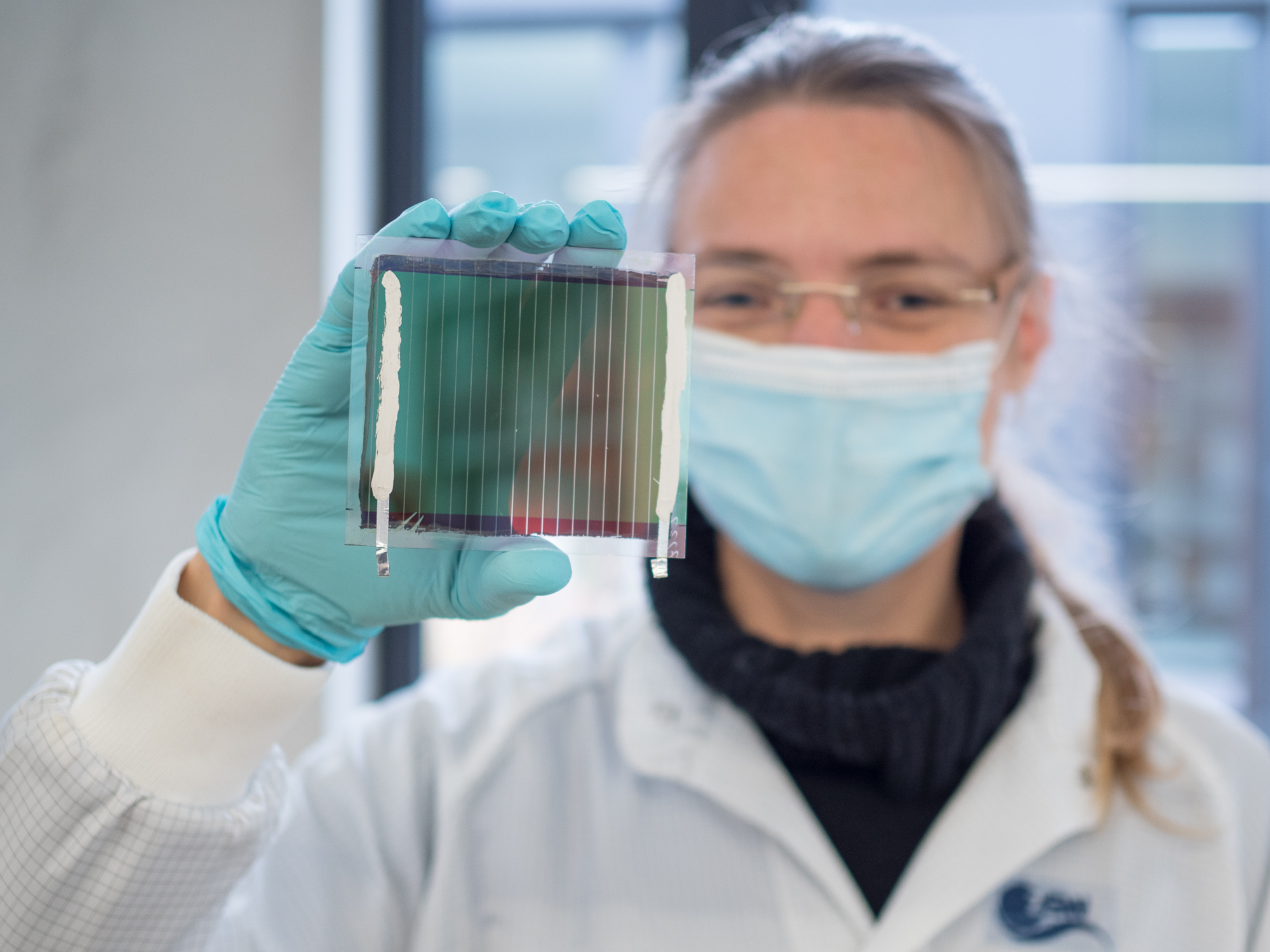
Product variety with stable, highly efficient perovskite solar cells
In principle, Perovskite thin-film solar cells open paths in rigid solar cells on glass or, if necessary, metal supports, as well as mechanically flexible, lightweight products. There are numerous possibilities to use perovskite in 2-terminal (2T) or 4-terminal (4T) components. This not only improves conventional products, but also develops new multispectral concepts with efficiencies of over 40%.
In addition, completely new products can be created. For example, lightweight Open up large-area industrial roofs for solar modulesthat could not be used with conventional silicon technology for weight reasons.
Perovskite perovskite tandem solar cells set new standards in photovoltaics: They combine significantly higher efficiencies with an improved ecological balance and enable real efficiency jumps for existing solar systems. At the same time, they open up completely new possible uses – from innovative building envelopes to vehicle applications to agri-photovoltaics. Thanks to their feasibility on rigid and flexible substrates, the modules can be used in a variety of ways.
The new competence cluster accelerates the transfer from top research to industrial application and thus drives the market maturity of a key technology for a sustainable, climate-friendly energy future.
PV research for industry
Strong Network
Our researchers are not only very well connected within the cluster but also represented at all industry meetings in industry. Get in touch with us at the PV Symposium, Intersolar, EU PVSEC or our own PV workshop. Connected in Baden-Württemberg, DACH, Europe and worldwide.
Upscaling Experts
We always work at the participating institutes with the aim of upscaling. Our process knowledge helps industrial partners along the entire value chain. From material analysis to process optimization to scaling up to 30 x 30 cm².
industry-relevant
Our annual Perovskite workshop successfully brings together industry and research. Whether as an industry professional or start-up, machine manufacturer or PV researcher: over 80 votes come together here every year. We listen and do together with the industry.
Contact us today!
More information can be found here

Partner
Here you will find an overview of the project partners and contact persons.

projects
presentation of our projects.

picture reference
- Photo header: kit
- Photo Scientist with hairnet on coating system: ZSW
Icons of Search Results for Factory – Flaticon
- Factory Icons Created by Freepik – Flaticon
- Solar Panel Icons Created by Freepik – Flaticon
- Statistics Icons Created by Freepik – Flaticon
- Prototype Icons Created by Freepik – Flaticon
Factory Icon Lighthouse Graphics
- rflor from the noun project
pictures of https://unsplash.com/de
- Partners: Radision US
- Projects: Startaê Team
- News: Bank Phrom